The Book of Books by Thomas Fulton;
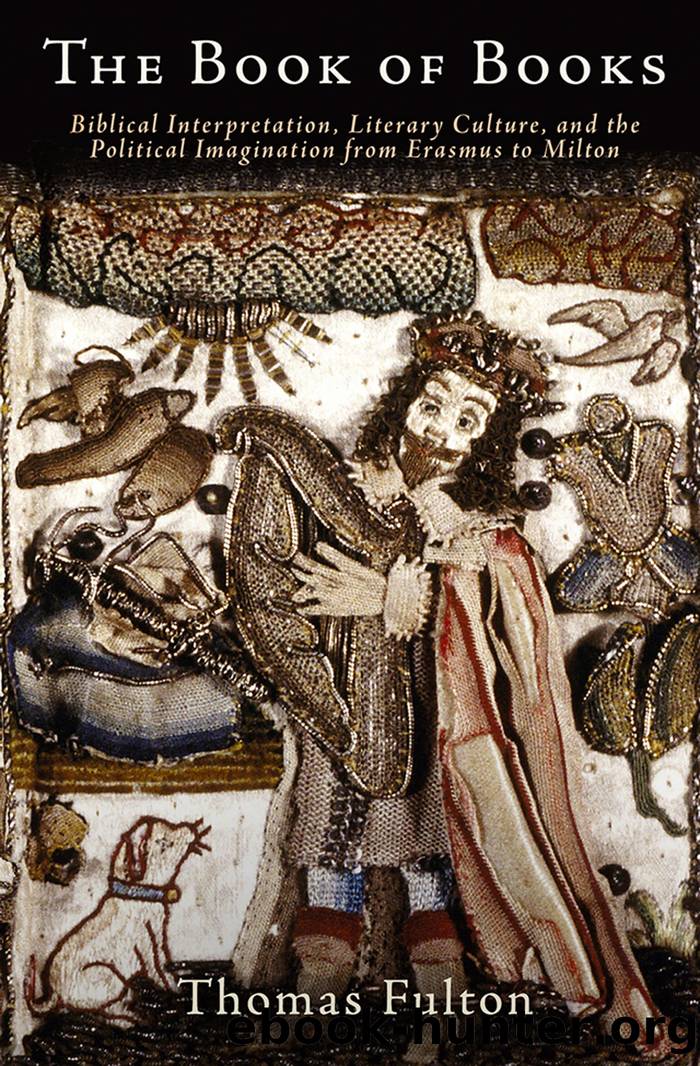
Author:Thomas Fulton;
Language: eng
Format: epub
Publisher: Lightning Source Inc. (Tier 2)
Published: 2020-06-15T00:00:00+00:00
The Paradoxes of Biblical Legalism
A passing comment by Muriel Bradbrook offers unexpected insight into Measure for Measureâs relationship to late-medieval allegorical drama. According to Bradbrook, the play resembles âthe late medieval Morality. It might be named The Contention between Justice and Mercy, or False Authority unmasked by Truth and Humility.â80 Bradbrookâs imagined titles pinpoint the playâs central homiletic concerns. But the playâs actual title more subtly reveals Shakespeareâs perspective on the relation of justice and mercy, as derived from biblical precepts and precedents. The irony in Shakespeareâs use of the biblical verse in its title is seldom fully appreciated. One reader who takes it into account is Harold Bloom, who offers another alternative title, âShakespeare should have called the play Like for Like, but he chose not to forgo his hidden blasphemy of the Sermon of the Mount, just sufficiently veiled to escape his own regimeâs frightening version of the law of the talion.â81 Although Shakespeareâs evident irony supports Bloomâs view of the playwrightâs fundamental skepticism, it seems more probable that the blasphemy lies not with the playwright but with those he criticizes. The phrase âmeasure for measure,â though it echoes the so-called lex talionis (an eye for an eye) derives from the doctrine of mercy in the New Testament that sought, at least in its own representation, to supersede that law. The reciprocity intended in the New Testament phrase is of giving, rather than taking away: âBe ye therefore merciful, as your father also is merciful ⦠condemn not and ye shall not be condemned: forgive, and ye shall be forgiven. Give, and it shall be given unto you: a good measure, pressed down, shaken together and running over shall men give into your bosom: for with what measure ye mete, with the same shall men mete to you againâ (Luke 6:36â38).
The phrase âmeasure for measureâ was alive in a proverbial usage whose retaliatory sense may not always have been conscious of its irony.82 Shakespeare, however, deliberately evokes an ironic dissonance between the proverbial retaliatory sense and the biblical doctrine of mercy.83 Indeed, his use of the phrase âmeasure for measureâ in his new Jacobean play seems a retrospective glance toward the biblical distortions of one of his earliest villains, Richard III, who would clothe his ânaked villainy / With odd old ends, stolân forth of Holy Writâ (Richard III, F 179; 1.3.335â336), and who, âwith a piece of Scripture,â convinced the world that âGod bids us do good for evilâ (1.3.333â334). In 3 Henry VI, the very words âmeasure for measureâ are used to confound, rather than support, the doctrine of mercy. âRevoke that doom of mercy,â says Richard ironically on the battlefield, a sword paused in an uncertain moment of clemency. âFor âtis Clifford,â and Clifford took the life of âour Princely Father.â Warwick agrees. Cliffordâs life must be taken: in a literal exchange of head for head, âMeasure for measure, must be answeredâ (F 157; 2.6.46, 55). As Richard boasts, âpiece[s] of scriptureâ are used here
Download
This site does not store any files on its server. We only index and link to content provided by other sites. Please contact the content providers to delete copyright contents if any and email us, we'll remove relevant links or contents immediately.
Professional Troublemaker by Luvvie Ajayi Jones(29744)
Empire of the Sikhs by Patwant Singh(23188)
Twilight of the Idols With the Antichrist and Ecce Homo by Friedrich Nietzsche(18760)
Plagued by Fire by Paul Hendrickson(17527)
The Sun and Her Flowers by Rupi Kaur(14618)
Norse Mythology by Gaiman Neil(13554)
Fangirl by Rainbow Rowell(9448)
A Journey Through Charms and Defence Against the Dark Arts (Harry Potter: A Journey Throughâ¦) by Pottermore Publishing(9333)
Adultolescence by Gabbie Hanna(9014)
Wonder by R.J. Palacio(8699)
Tools of Titans by Timothy Ferriss(8579)
Becoming Supernatural by Dr. Joe Dispenza(8361)
How to Bang a Billionaire by Alexis Hall(8266)
Wonder by R. J. Palacio(8226)
Crystal Healing for Women by Mariah K. Lyons(8000)
The Road Less Traveled by M. Scott Peck(7722)
The Lost Art of Listening by Michael P. Nichols(7609)
The Witchcraft of Salem Village by Shirley Jackson(7423)
The Institute by Stephen King(7147)
